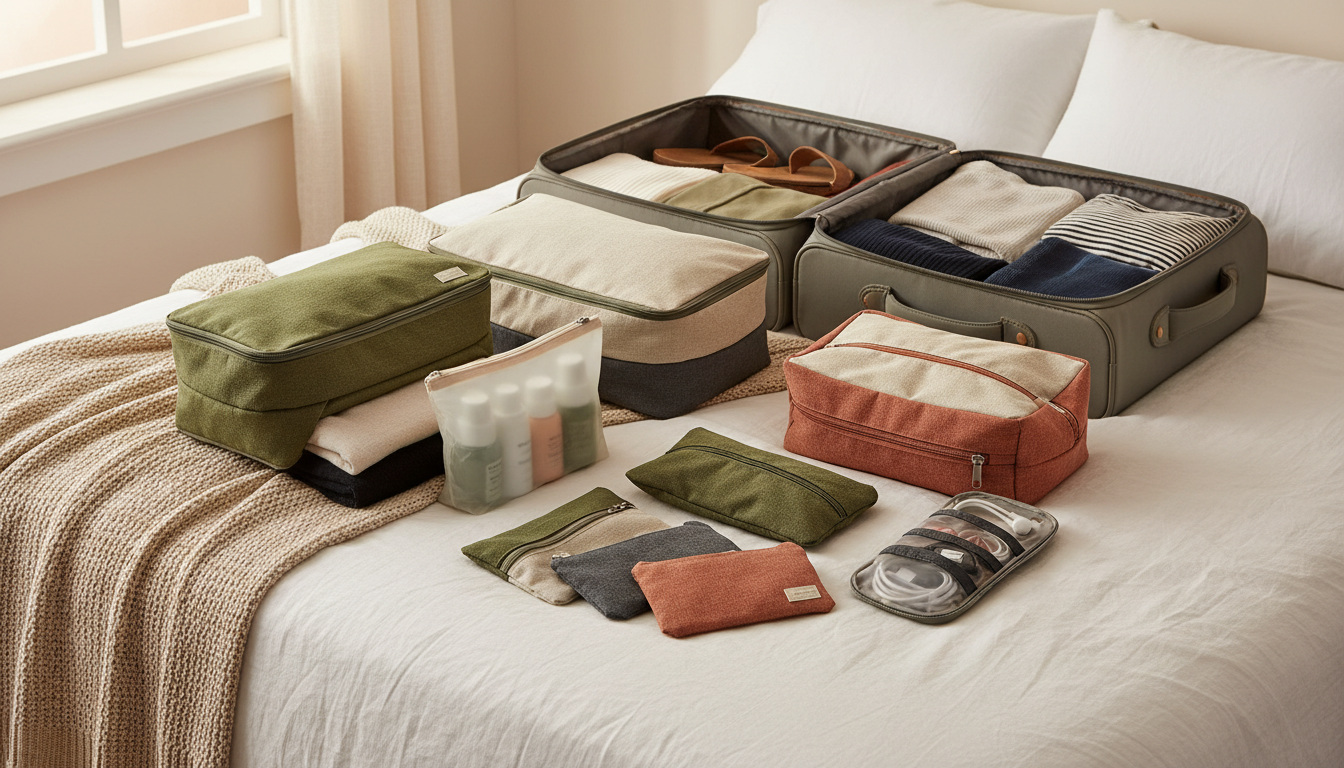
Start with the problem, not the product
Travel organizers are most useful when they solve a repeat problem: loose charging cables, leaking toiletries, or clothing that is hard to find. Before shopping, unpack your usual travel bag and identify which items genuinely get lost, tangled, or crushed. If nothing causes trouble, an organizer may only add weight.
Compare three common options
Packing cubes
These separate clothing by type and make items easier to find. They do not automatically reduce baggage weight. Compression styles can make clothing more compact, but they may tempt you to exceed your airline’s weight allowance. Check cube dimensions against your bag’s interior rather than relying on a “universal fit” claim.
Toiletry pouches
Look for washable linings, a zipper that opens widely, and pockets sized for your actual containers. A hanging hook is helpful only when accommodation has somewhere practical to hang it. If you carry liquids in cabin baggage, confirm your airport’s current security rules before choosing a pouch.
Electronics organizers
A compact pouch can keep power adapters, charging cables, and small accessories separate from clothes. Check the number and width of elastic loops: a slim cable loop may not accommodate a large power brick. Avoid buying a bulky case for just one cable and one charger.
Five checks before you buy
- Measure: record your bag’s available length, width and depth.
- Inventory: put the items you want to organize on a table and measure the largest one.
- Material: prioritize washable, easy-to-dry fabric if the pouch will hold toiletries.
- Access: choose openings that let you reach frequently used items without unpacking everything.
- Cost per use: consider how many trips you realistically take each year.
What to skip
A matching set of seven organizers is not always more useful than two well-sized pouches. Avoid poorly documented dimensions, unnecessary compartments and claims that compression alone guarantees airline compliance.
A simple packing test
Before committing, place the intended contents in an existing pouch or reusable bag and test whether the grouping improves your packing routine. If it does, you know which size and layout to look for.
For the broader trip-planning process, read our carry-on packing checklist. Our guide to avoiding impulse purchases is also useful when comparing inexpensive accessories.
Disclosure: This article contains no affiliate product links. Product listings and prices should be independently checked before purchasing.
More useful guides from this journal
For the next step, see packing cubes versus compression bags, carry-on packing checklist.
Leave a Reply